
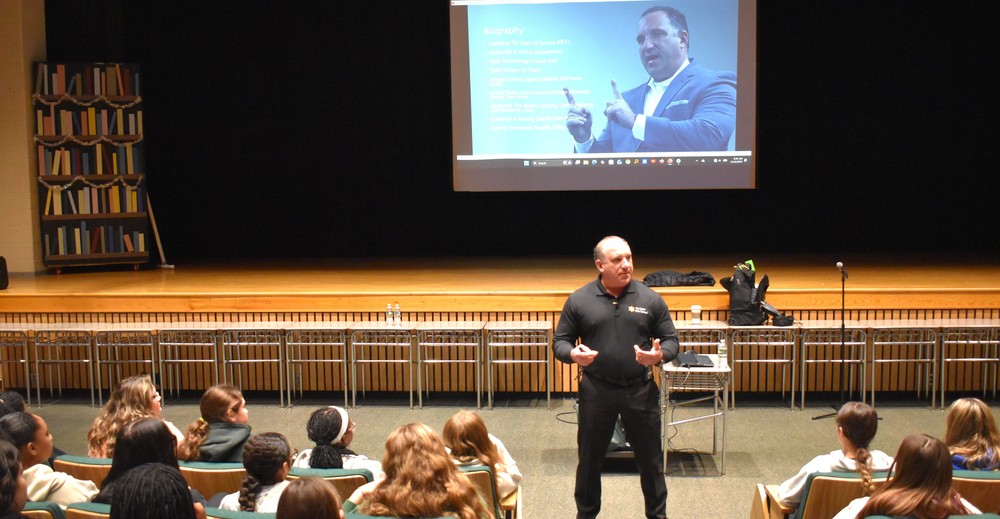
As part of the Middle School’s ongoing commitment to developing responsible digital citizens, students recently attended two assemblies led by nationally recognized cyber-crimes expert Detective Richard Wistocki, who addressed safe internet use and the serious consequences of cyberbullying.
Detective Wistocki works as a consultant and instructor when he’s not coaching students and parents on how to stay safe online. He’s spoken to over 300,000 students (and growing) in thousands of presentations. This past fall, he spoke at over 40 schools. Annually, he provides internet crime training to over 6,000 police officers nationally.
Drawing on his decades of experience, Detective Wistocki implored students to be alert to the red flags of digital threats and shared real-world examples of the negative consequences of not understanding them.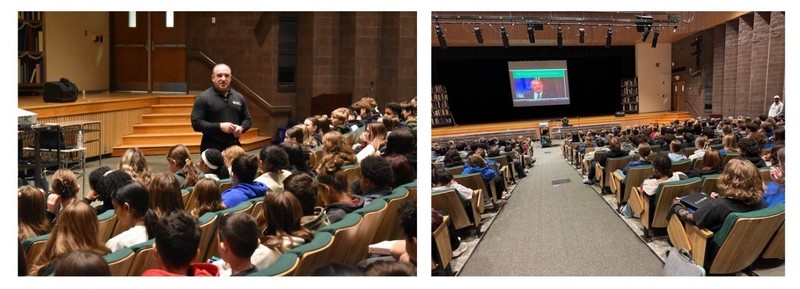
“My job today is to empower all of you to not be victims of internet crime,” he said. “No one has the right to make you feel bad online or do something you don’t want to do. I’m sick and tired of kids dying because of this.”
During his two presentations, Detective Wistocki talked about online safety on phones, computers and gaming systems; being able to recognize the dangers of popular apps; the dangers of cyberbullying, online threats and inappropriate content; and peer pressure and real-world digital risks.
Detective Wistocki assured students that no offender is anonymous because digital actions leave traces and can be investigated by law enforcement — which is why safe behavior matters, and that includes what students do online. He spoke with them about the importance of reporting cyberbullying and how internet investigations work.
If a victim collects the correct data after he or she realizes a cybercrime was committed, that helps law enforcement officials do their jobs quickly and solve it. He told them to take screenshots of all interactions, including email addresses, phone numbers, gamer tags and other details, and print copies of everything. He also recommended writing detailed notes to provide to law enforcement and save all digital files on a portable thumb drive for investigators.

Detective Wistocki also stressed victims should avoid reporting incidents on a particular website or to the social media company where the crime occurred. Actions such as deleting or banning accounts could destroy evidence.
“If we have this information, we can shut down their whole operation within two hours,” he told students.
Detective Wistocki reminded students that internet gaming platforms are the most dangerous online places for them to be because parents often don’t realize their children can communicate with strangers in the games.
“Roblox is the worst place,” he said, after asking for a show of hands as to who is on this platform. “There are more predators there than any other game.”
Detective Wistocki also warned students about popular app usage, noting it’s common knowledge kids often lie about their ages in order to join. And for many of those apps, kids often unknowingly connect with adults or get exposed to inappropriate content, which can lead to all kinds of problems.
He reminded students that parents and guardians “own” the Smartphones they use, because those adults are the ones who buy the phones and pay for the services used. Parents and guardians have the right to see what their children are doing at all times and to know all passcodes because they’re responsible for their children’s technology and behavior in real life and online.
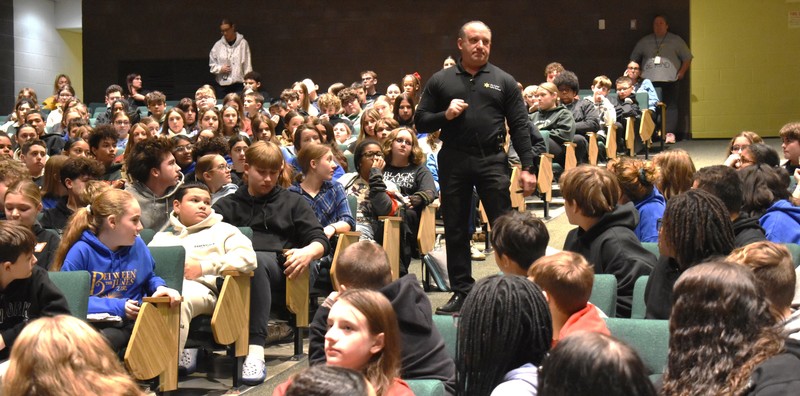
“In all 50 states, until you’re 18, you own nothing,” he said. “Your parents are responsible for everything you have. They are the ones who allow you to have things. There’s no such thing as privacy for children. If you change your passcode and don’t tell your parents, you’re probably doing something wrong. Think about that.”
Detective Wistocki also reminded students huge red flags to notice are when someone online tries to move conversations to private chats; if someone tells a child not to tell parents what they're doing; or if someone asks for explicit photos, leading to sextortion, or blackmail. He also said he believed having phones and tablets charging in bedrooms overnight give predators opportunities to engage in risky or private communications when parents aren’t watching.
He acknowledged to students that parental threats of taking away devices don't work and equally implored students to talk with their parents about developing a “golden ticket rule.”
That’s because children rarely tell their parents when they make a mistake online. By using the golden ticket rule when telling their parents if they’re being bullied, exploited or extorted online, kids know they won’t be in trouble and the parents get the information they need to help.
“Go to them first,” Detective Wistocki said, adding pastors and principals to the mix of “3P” people who can help. “They will help you if something goes wrong.”
He also reminded them of the long-term consequences of what they share online.
“If you wouldn’t want a parent, pastor or principal to see it, don’t send it,” he stressed.
Detective Wistocki also spoke to students at great length about sextortion, noting blackmailers go after girls for more videos and pictures; and go after boys for money.
“You are a victim of sextortion if you give in,” he said. “And if your relationship with someone requires you to take and send naked pictures of yourself, that’s a toxic relationship. Protect yourself.”
Detective Wistocki emphasized the importance of always being a good digital citizen, as bad choices can haunt someone forever.
“If you see something, say something, report something,” he said.
The important messages in his presentation were reinforced by Assistant Principal Thomas Rickard.
“These are mature and sensitive topics,” Mr. Rickard told students. “But they’re important to talk about. What Detective Wistocki is saying is true and happens every day. We – everyone here and your families --- do not want this to happen to you. You do not want this to happen to you.”