

TOO COOL!
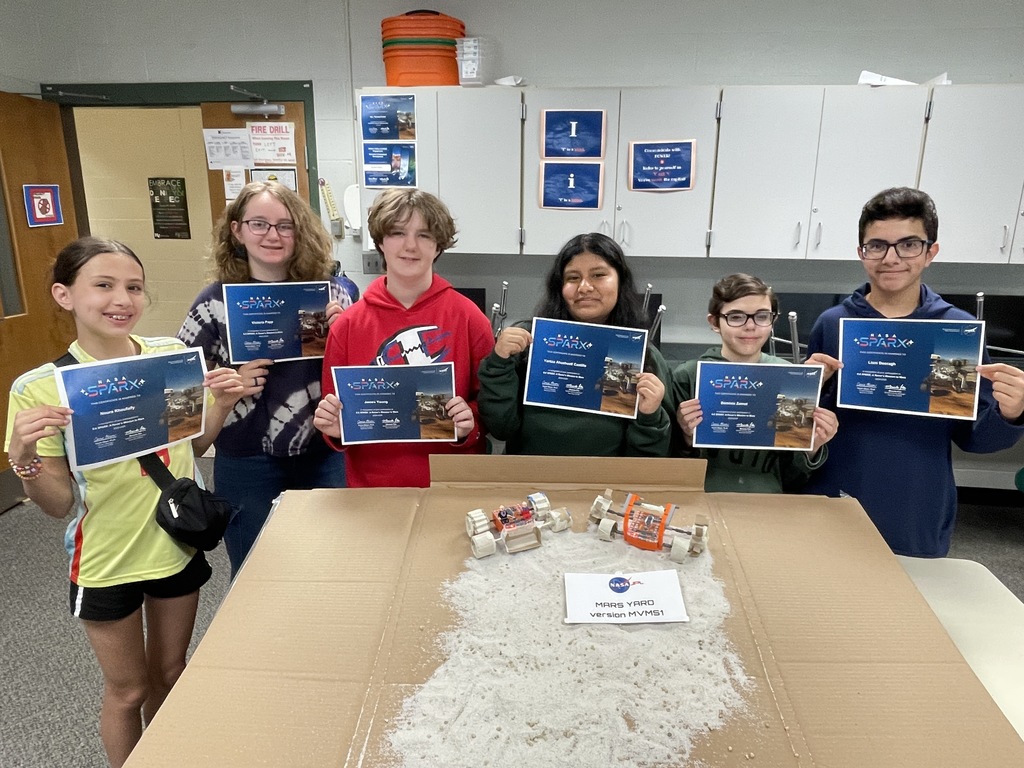
Middle School technology teacher Teresia Parker recently worked with small group of students after school to work in NASA's SPARX (Sparking Participation and Real-world eXperiences) program. The Engineering Design Process (EDP) is an iterative process involving a series of steps that engineers use to guide them as they solve problems and is crucial to mission success at NASA. SPARX provides educators with hands-on, standards-based activities, and related training resources, to bring EDP to their students.
Students utilized the engineering design process to learn about the challenges and difficulties of exploring other worlds and applied that engineering design process to help the NASA Mars AstroBio Bot to complete its mission on Mars. For this particular challenge, students needed to design wheels that would help the rover move over the surface of Mars. Students used challenge specific materials and tested their designs in the “MS Mars Yard,” modeled after JPL's Mars Yard. There were plenty of failures and lots of learning.
“Space is hard,but our students will continue to learn about the world around them and engineer solutions to make our world a better place,” said Mrs. Parker. “By completing these challenges, participants join NASA as part of the next generation of explorers


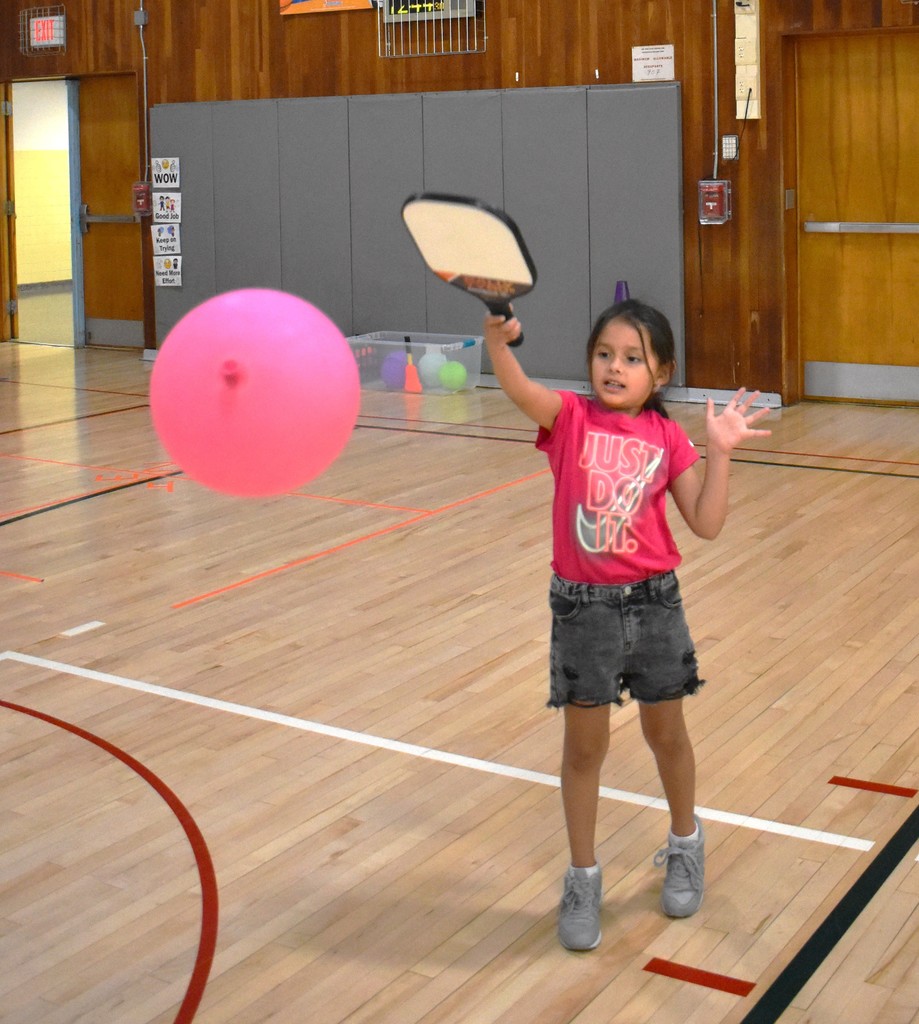
Leyla Johnson’s ES K-2 students have been working on a variety of fun, creative, manipulative stations including striking, throwing and catching, volleying with hands and with an implement, hula hoop challenges and creative scarf challenges.
Students worked with a variety of equipment trying individual, partner, and group challenges working on manipulative skills.
In Physical Education, manipulative skills involve using one’s body to move or control objects with accuracy and speed, often involving gross motor skills like throwing, catching, kicking or striking. These skills are crucial for developing both gross motor coordination and fine motor control and are an amazing foundation for multiple sports and activities, while also being a lot of fun!




Tomorrow, June 14, is Flag Day! Today, Otisville Elementary held an all-school outdoor assembly to talk about the importance of this day, to be reminded of a few facts about the U.S. flag and to sing a few songs. It's a great civics lesson!
Don't our little students look adorable with their specially made "flag hats?"
Fifth-grader Leah Galligan spoke about Flag Day, and provided history on how the day is celebrated in various places.
Third-grader Zephyr Welsh shared fun facts about the flag.
Selected fifth-grade flutists played "Yankee Doodle Dandy," led Band Teacher Maria Fenfert:
Elizabeth Claus
Adelyn Carroll
Mickayla Brink
Natalia Sierra
Amelia McCarey
Zahra Mechkour
Ailani Fermin-Gonzalez
Paislee Dragone
Alayna Reynolds
Iliana Rivera
Sofia Raigoza
And, Chorus Teacher Skyler Klein led the entire school in singing: "You're a Grand Old Flag," "America the Beautiful" and "The Star Spangled Banner."
Flag Day, celebrated annually on June 14, is a national observance that commemorates the adoption of the American flag by the Continental Congress on June 14, 1777. It's a day to honor and show respect for the U.S. flag and what it represents.


Jenn Kemmerer’s and Cheryl Wilson’s IS fourth-graders, like other district fourth-graders, are learning about energy!
They’ve built catapults, which are great representations of elastic potential energy. And in their recent pendulum lab, students explored how energy transforms between potential and kinetic energy! What a fun STEM learning experience!
• Elastic potential energy is energy stored when one pushes, pulls or changes the shape of an elastic object, like if a rubber band is stretched between fingers or a spring is compressed. When the rubber band or spring is released, it can use that stored energy to move, showing how potential energy can turn into kinetic energy.
• Kinetic energy is the energy of motion, meaning it's what makes things move. A rolling ball or a car driving has kinetic energy. The faster something moves and the heavier it is, the more kinetic energy it has.
• A pendulum lab demonstrates the relationship between potential energy and kinetic energy, showing how they transform into each other as the pendulum swings. The lab typically involves students building a pendulum and analyzing its motion to understand where potential and kinetic energy are greatest and least.


Danielle Zamorski’s high school health classes participated in several activities in class in recent days that involved information on alcohol and its impact on health and wellness using the Fatal Vision Program. It’s an important topic!
Students defined alcohol use, misuse, and abuse, and distinguished among them using real-life examples. They identified the short-term and long-term effects of alcohol consumption on physical, mental, and emotional health. They described how alcohol impacts the brain and body, especially during adolescence. Students examined the relationship between alcohol use and risky behaviors, including impaired driving, violence, and relationships.
Classes also analyzed the social, legal, and academic consequences of underage drinking and alcohol abuse. Each group evaluated how peer pressure and media influence alcohol-related decisions among teens.
Moving forward, classes will be working on refusal skills and strategies to make informed decisions regarding alcohol use. Students will identify resources for help and support, including school counselors, hotlines, and community programs and reflect on personal values and goals to assess how alcohol and drug use may interfere with wellness and future success.
The Fatal Vision program is a hands-on simulation program used to educate people about the dangers of impaired driving caused by alcohol, opioids, marijuana, and other substances, as well as concussions. It uses specialized goggles and activities to simulate the physical and cognitive impairments experienced when someone is under the influence. The googles have various features that distort vision, impair coordination, and slow reaction time.


Intermediate School fifth-graders had a blast during their recent field trip to LEGOLAND New York! Who wouldn't?
The park offers a unique and engaging experience centered around LEGO bricks, including interactive attractions, hands-on workshops, and themed lands that can be educational and entertaining for students. The park's focus on LEGO building and creativity aligns well with STEM subjects like engineering!


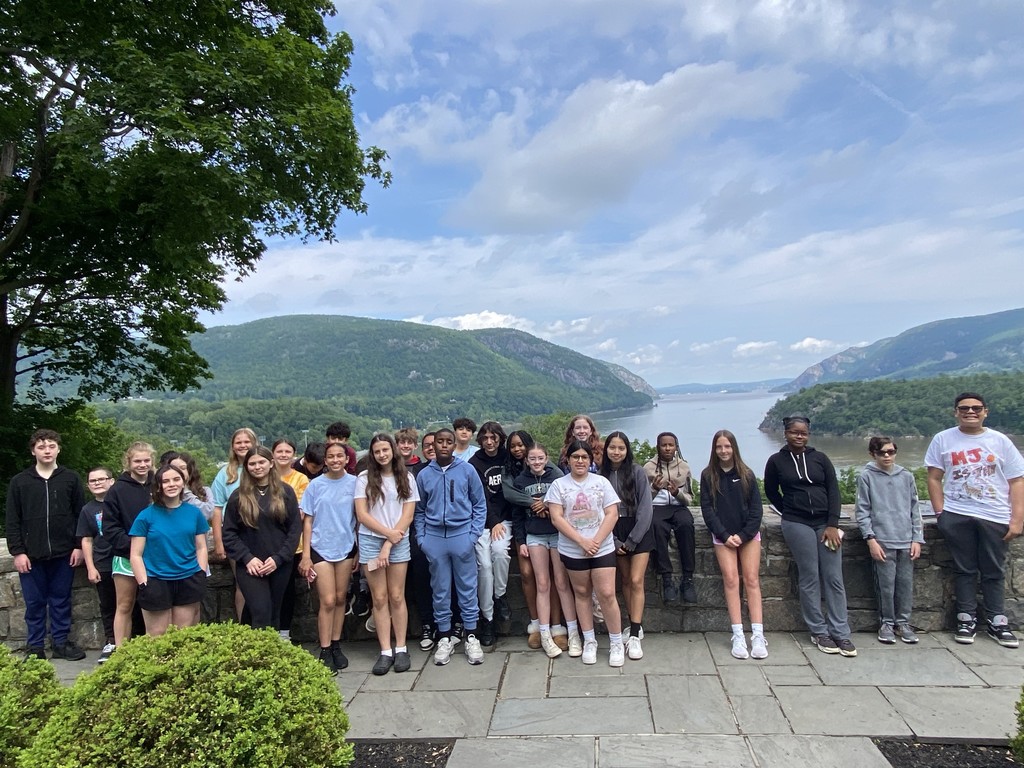
Seventh-grade students took a recent field trip to the U.S. Military Academy at West Point! This trip venue was selected for its rich historical significance and its powerful connections to the New York State Social Studies curriculum.
As the 250th anniversary of the American Revolution nears, this visit offered students the chance to explore local history with national impact. West Point played a key role in the Revolutionary War and continues to serve as a symbol of leadership, service, and civic responsibility. Students were able to connect their classroom studies of the American Revolution, early U.S. government, civic responsibility and geography to a site of real historical significance.
During the visit, students explored the role of West Point in shaping the nation’s military history and its strategic importance during the Revolutionary War. This hands-on experience brought classroom learning to life, deepening student understanding of topics such as the founding principles of our nation, U.S. geography, and the structure of our government and military institutions.


Congratulations to Senior PJ Duke on his recent impressive performance at the Senior World Team Trials. Coach Scott Hendershot is proud to share that PJ competed in the 70 kg weight class, beating the 2025 NCAA Division I 157-pound weight class champion in the quarterfinals. He followed that up by defeating the 2025 NCAA Division I 149-pound weight class champion in the semifinals. In the finals, PJ secured the title by overcoming a three-time NCAA Division I All-American!
With this victory, Coach Hendershot said, PJ earned a spot at Final X, where he will compete for the opportunity to represent Team USA at the Senior World Championships in Croatia!
Additionally, PJ has been named the winner of the 2025 Junior Dan Hodge Trophy. The award is named after the former Oklahoma national champion and is presented annually to the nation’s best high school wrestler by WIN Magazine.
The late Dan Hodge won three NCAA titles for the University of Oklahoma (1955-57) and never allowed a takedown in his college career. He also pinned 36 of his 46 victims.
In that article, Coach Kevin Gallagher said: “You don’t get a bigger honor. I couldn’t be happier for PJ. He is a gifted athlete, but also the hardest worker I’ve ever seen. He is a great teammate and leader. He is the kid that is jumping up and down for a freshman wrestler who gets a big win. He helps in practice. PJ is just such a humble, well-liked kid.”
“I have to thank Coach Kevin Gallagher for all his help and support over the years” PJ said in the article. “Minisink Valley is my home. Everyone here is family.”
In that same article, Coach Gallagher added: “I heard him say his style is ‘I just love wrestling.’ He loves to score; it is fun for him. What a lesson for young wrestlers who put pressure on themselves. His ways, leadership and training habits have rubbed off on other kids in our program. Until PJ loses, I don’t ever doubt him.”
PJ is New York State’s 11th four-time state champion while representing Minisink Valley, compiling a 152-1 career prep record and won Outstanding Wrestler honors at the 2024 and 2025 state tournaments, winning every match by pin or tech fall.

BRAVO! BRAVO!
Kudos to the 21 singers and musicians who performed at last evening's Otisville Elementary Band/Chorus Recital! (And to teachers Syler Klein and Maria Fenfert who prepared them their performances!) It was a wonderful evening!
The plan was to have an outdoor recital, but the gathering was brought indoors when dark clouds arrived. Everyone quickly pivoted and student performances continued as planned! Thank you to everyone for their flexibility!


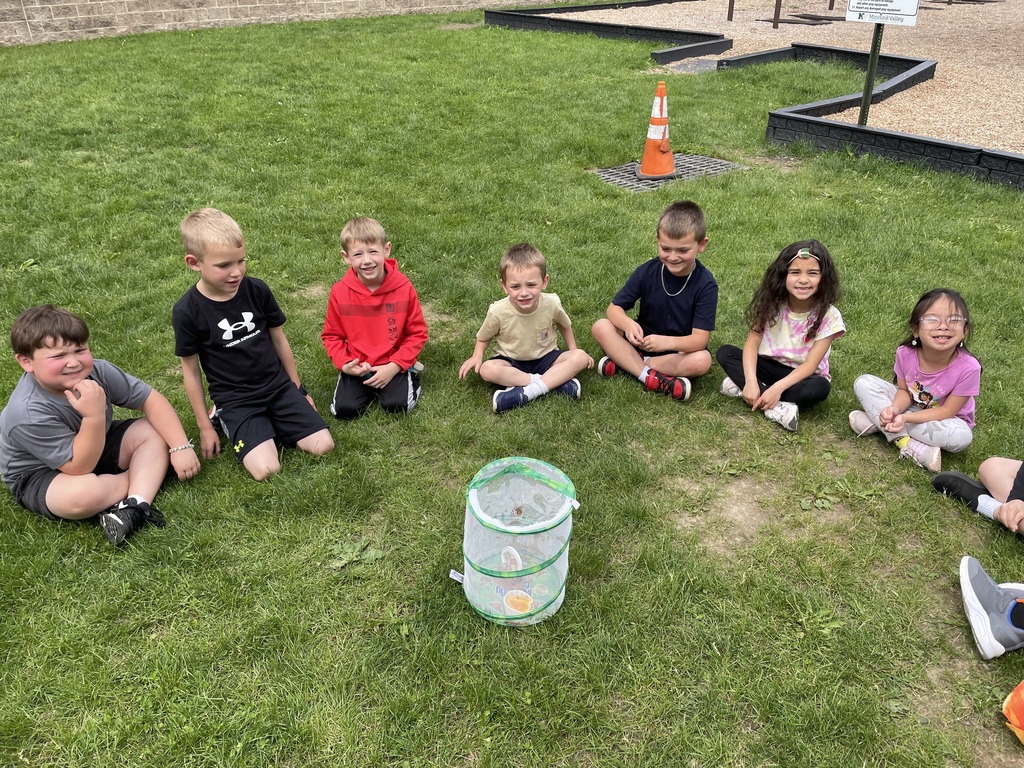
Sherri Jennings’ and Jessica Kahn’s/Julia Ferguson’s Otisville kindergarteners were among the kindergarten classes completing recent lessons about the life of a butterfly! And as part of that, students knew they would ultimately be releasing their new butterfly friends outdoors to where they will continue to thrive.
These little students loved this learning experience, made possible through the generosity of the Otisville PTO!
Kindergarteners often study butterflies in science to introduce them to the concept of metamorphosis and the fascinating life cycle of insects. It's a visually engaging way to see how living things grow and change in this unique life cycle. In addition to this very fun and fascinating hands-on learning experience, seeing the butterfly’s life cycle of an egg to caterpillar to chrysalis to butterfly offers lessons in patience, responsibility, and the wonder of nature in addition to the important science component.




CONGRATULATIONS to the Otisville and Intermediate School Girls on the Run (GOTR) teams, who competed with grit at this past weekend's 5K Race at LEGOLAND New York! We know they had a wonderful time and represented the district with distinction! Thank you to everyone at both schools who made our students' GOTR experiences so memorable!


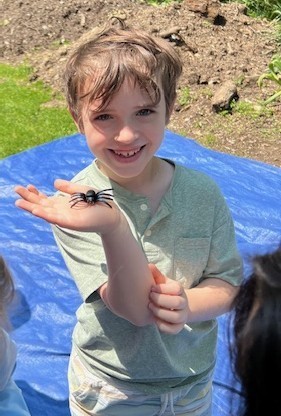
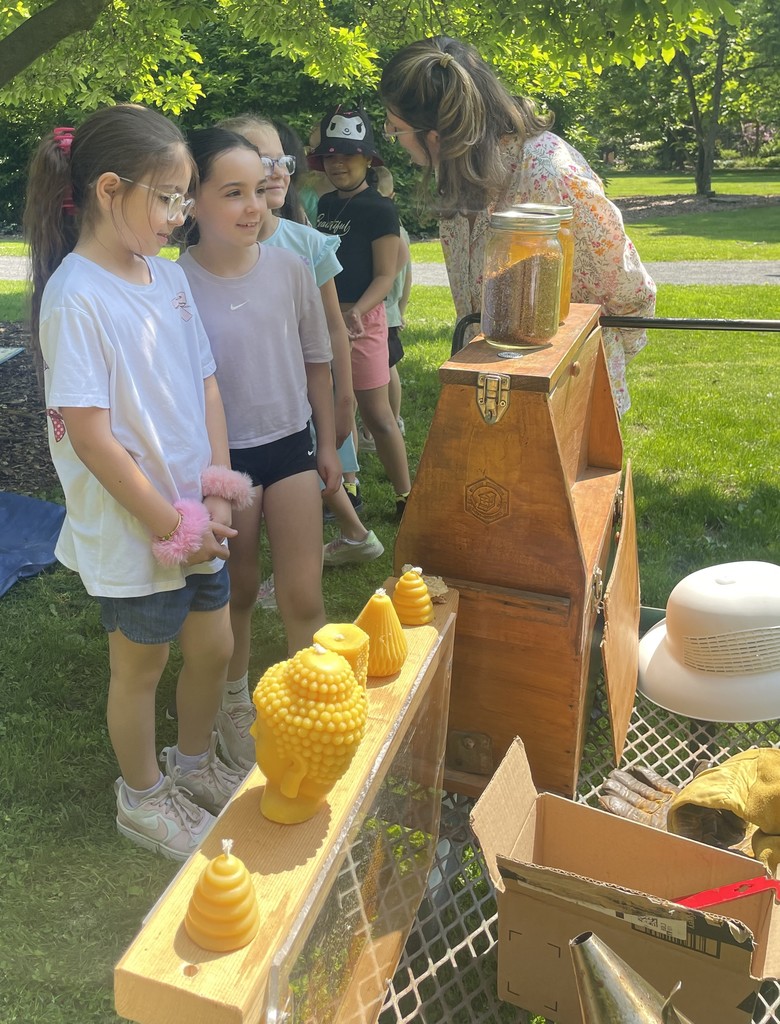
Otisville second-graders recently had a wonderful and SUNNY field trip to the Orange County Arboretum in Montgomery, where they had a fun outing filled with learning courtesy of the Arboretum’s GEM Program!
The Orange County Arboretum's GEM (Garden Exploration with Master Gardeners) program is an environmental education program for elementary school groups (grades K-3). It's offered during May and June where Master Gardeners teach students about topics like beekeeping, composting, vermiculture, recycling, and good vs. bad bugs. Students also learn about plant identification and get to pot a plant to take home.





Kudos to students at Otisville Elementary and the Intermediate School on the success of their recent health and wellness collection efforts which will benefit Minisink Cares!
At Otisville Elementary, the Kiwanis K-Kids Program spearheaded the effort to collect personal hygiene items donated by students, faculty and staff. Their Intermediate School Kiwanis K-Kids peers joined in on this initiative with equal success!
Together, both schools collected 1,180 personal hygiene items! That's amazing! THANK YOU to everyone who was a part of this important effort to support our community!


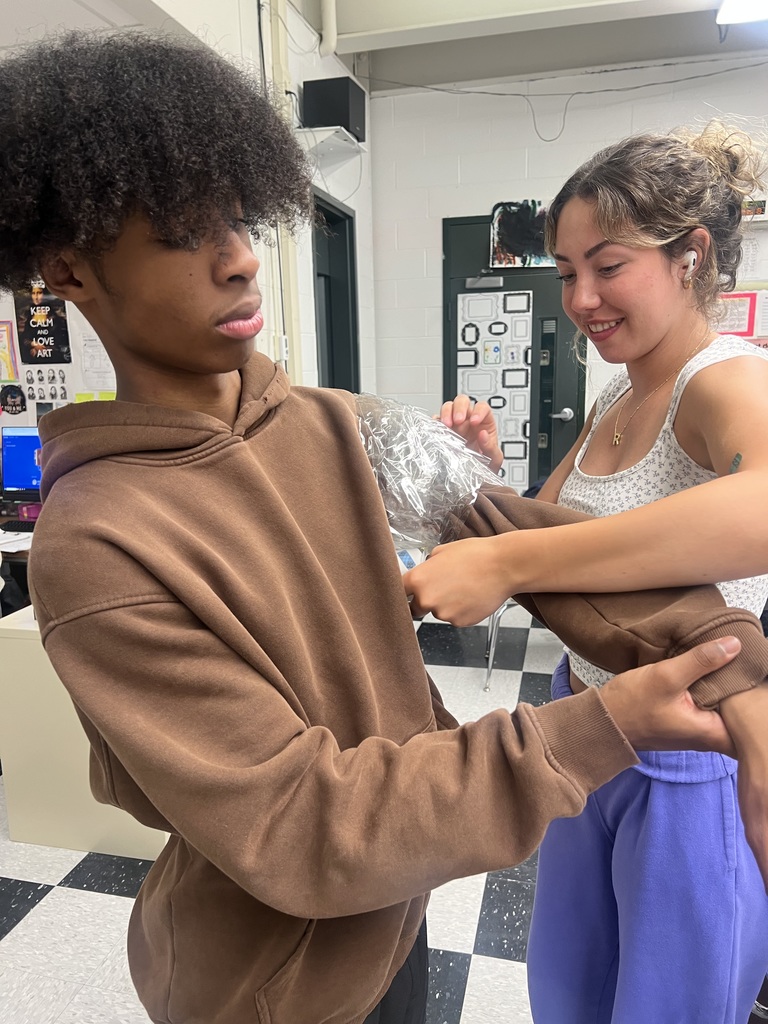
Cayla Tangney’s High School “Sculpture” students’ final project, “Tape Figures,” is by far one of their favorite projects of the school year! For this project, students wrapped their own bodies (or helped a friend to do the same) with clear packing tape.
They worked sticky side out for a few layers and then sticky side in to make sure the structure was strong and sturdy enough to stand or sit on its own. This project was a reference to site-specific and installation art.
To begin, students took a class "field trip" around the school so they could take photos of the building location they wanted to use for their installation. Then students returned to the classroom to begin wrapping! The project took a few weeks and A LOT of tape.
Once completed, students walked around the school, sculptures in tow, to take photos in their appropriate locations. The results were a great mix of comedy, creativity and introspection.
•Installation art is a type of visual art where the artist creates a three-dimensional artwork that transforms the perception of a space. It's often site-specific, meaning it's designed for a particular location, and can be temporary or permanent. Installation art aims to create an immersive experience for the viewer, encouraging them to interact with the artwork and its surroundings.
•Tape art sculpture involves creating three-dimensional artwork using adhesive tape, like duct tape, packing tape or masking tape. Artists can manipulate the tape to form shapes, layer it for depth, or combine it with other materials like paint. This art form can be used to create installations, wall art, or even sculptures that interact with the environment. •Unlike traditional paintings and sculptures, tape art can be applied anywhere, including the doors, ceilings and floors of galleries.
•Tape art traces its roots back to the 1960s when a few artists began experimenting with masking tapes and adhesive materials to create temporary installations and murals. The use of tapes offered them freedom and flexibility, enabling them to work on a variety of surfaces and experiment with different compositions.



The senior members of the Boys Varsity Lacrosse Team were honored for their many contributions to the team during its recent Senior Night! Congratulations and best wishes to:
•Hudson Bosland, #13, Defense
•Patrick Cherry, #1, Defense
•Harrison Greaves, #4, Midfield
•Aaron Kelter, #8, Midfield
•Eric Lukiansky, #5, Midfield
•Cole Sanfilippo, #3, Defense
PLUS: Members of the Minisink Valley K-2 Boys Youth Lacrosse program attended this game and helped as ball boys! After the game, the varsity team had a post-game catch with these future varsity lacrosse players! Everyone had a blast of a time!


Lisa Assaiante's Otisville K/1 students recently completed an adorable butterfly life cycle craft! They painted lady caterpillars which recently emerged into painted lady butterflies. They know a butterfly's life cycle is: Egg --- caterpillar --- chrysalis --- butterfly!


BREAKING SATURDAY AFTERNOON NEWS!
Our Varsity Girls Lacrosse Team is FINAL FOUR BOUND after their huge 17-6 win over fourth-seed Vestal today in the NYSPHAA Girls Lacrosse Class B Regional matchup!
PLUS: CJ Kuiken scored her 200th goal at today's game!
Next up: The four regional winners now advance to the NYSPHSAA Class B SemiFinals on Friday, June 13. Winners advance to NYSPHSAA championships on Saturday, June 14! You got this, ladies!


Kudos to the Intermediate School’s “Girls On The Run” team for their ongoing work and commitment to be part of activities that build character development, self-confidence and team bonding along with a love for physical activity and, of course, running!
The girls recently completed a service project to create uplifting cards for senior citizens to brighten their day. These cards are planned to be delivered to the Promenade at Middletown and/or Bon Secours.
PLUS: The team has been training for their season culminating 5K race which will take place takes place this Sunday, June 8 at LEGOLAND New York. Good luck to all!


The Otisville Elementary Girls on the Run (GOTR) Program is also competing in the June 8 5K Race at LEGOLAND New York! We're so proud of their efforts! They, too, have working hard to be part of activities that build character development, self-confidence and team bonding along with a love for physical activity and, of course, running! GOOD LUCK TO ALL!

ES kindergarteners took a fabulous field trip to Pierson’s Farms yesterday, June 4!
It was a great day to be outdoors, enjoy the sunshine with friends, meet some goats, try out the trike track, tube gliders, spider web and gravel pit and mine for gems! Students even learned about plants by planting their own little plant to bring home and care for!


