
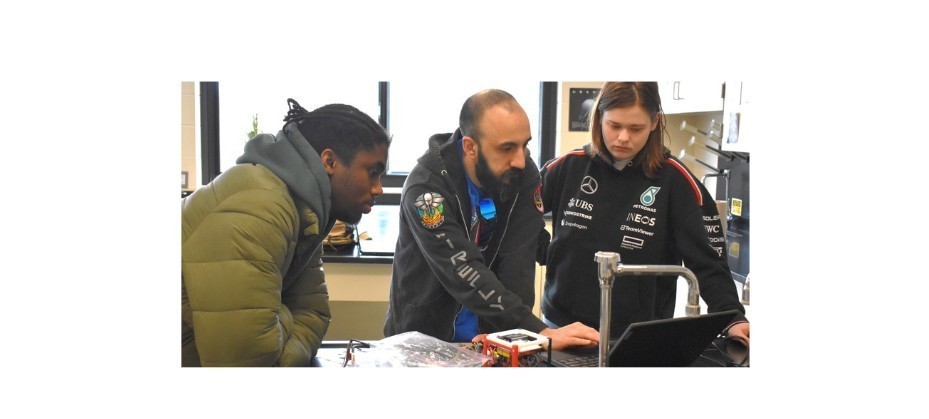
Media attention has been buzzing over the recent Artemis II launch, and soon two high school students will get their own taste of that excitement when their CubeSat nanosatellite rises into the stratosphere to gather crucial weather data on an April 20 High Altitude Balloon (HAB) mission in upstate New York.
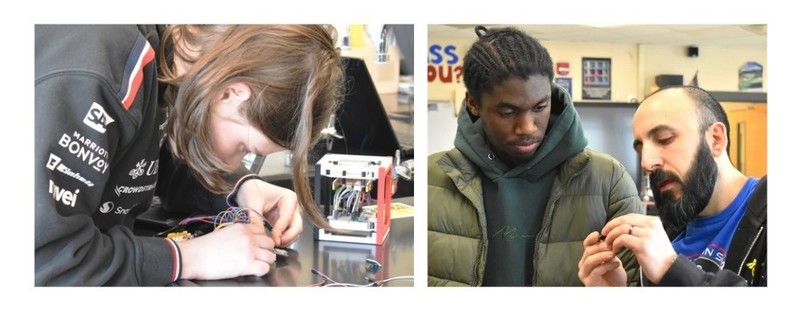
Seniors Audrey Stokes and Ethan Huggins-Williams worked with Earth Science Teacher Vincent Napolitano to recently build the tiny satellite. Their work was based on Mr. Napolitano's professional development work last summer with the Teacher in Space (TIS) education program, which has the mission of stimulating student STEM interest by providing teachers with engineering curriculum focused on space science experiments, space flight opportunities and industry connections.
CubeSats are special small and affordable satellites which are highly useful for various scientific and educational purposes. These miniature satellites are designed in a cube shape, typically measuring just 10 centimeters on each side. This size makes them easy to build and launch into space. CubeSats can be equipped with various sensors, such as temperature, light, humidity, and gyro sensors, which help scientists gather important data about Earth and beyond.
“I built a CubeSat, which is a small arduino and 3D printed structure, that was launched on a high altitude weather balloon 20 miles into the air,” said Mr. Napolitano, a self-professed space geek. “It collected all sorts of data --- temperature, pressure, altitude, photosensor and more. This past fall, they sent me all of the material to build it with students. Building a CubeSat is cool because it allows students to design, build, and launch functional satellites. These miniature, modular satellites provide hands-on experience in aerospace engineering and enable rapid testing of new technologies in orbit.”
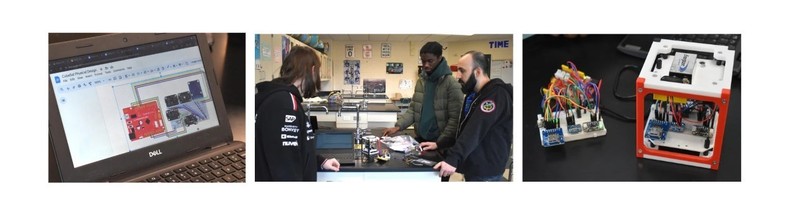 CubeSats can be used for Earth observation (light and temperature sensors can monitor weather patterns, track climate change and support agricultural practices by providing real-time data on crop conditions); scientific research in space; technology testing and educational projects.
Audrey saw the CubeSat project as a great opportunity to learn how meaningful weather data is gathered.
“Mr. Napolitano figured that some of us would enjoy doing this project ourselves,” she said. “In the absence of robotics, it filled the void of my interest in the design of scientific instruments. The process of assembling the CubeSat gave me skills that I can pass on to others and that I can pass along in the future. It also reinforced my C++ skills.”
Ethan agreed, noting the experience is helping him to narrow down his specific computer science interests.
“Currently I’m interested in the video game industry but if other experiences, like the one we’re doing, interest me I might think about switching careers,” he said. “During this experience, I learned what working on a group project might look like and how it might benefit me in taking more group projects instead of just going at it solo. This CubeSat may have some very important skills and lessons to help reach my goal.”
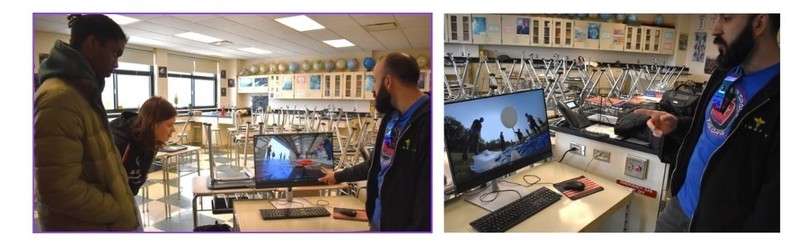
As they neared completion of their CubeSat, Noah Luogemano, TIS program manager, trainer, and curriculum designer, visited the high school to meet with Audrey, Ethan, and Mr. Napolitano, discuss their work, and explain the data the CubeSat would collect once launched. He shared videos of other CubeSat launches and recoveries, featuring enthusiastic science teachers from across the country eagerly tracking their satellites and retrieving them from trees and dry fields.
Their CubeSat has been delivered to Mr. Luogemano, and is already operational and collecting data.
CubeSats like Audrey’s and Ethan’s are frequently launched on weather balloons, officially known as high-altitude balloons (HABs). These balloons, often filled with helium, carry payloads up to the stratosphere. They typically travel 30 km (roughly 90,000 ft) or higher to simulate the space environment, test hardware and gather data before returning to Earth.
But, their project was more than a satellite build, launch and return.
“Science inspires me,” added Audrey, “because it provides insights into how things work that fuels the innovative ideas that we use on a daily basis in order to make informed decisions about current issues.”